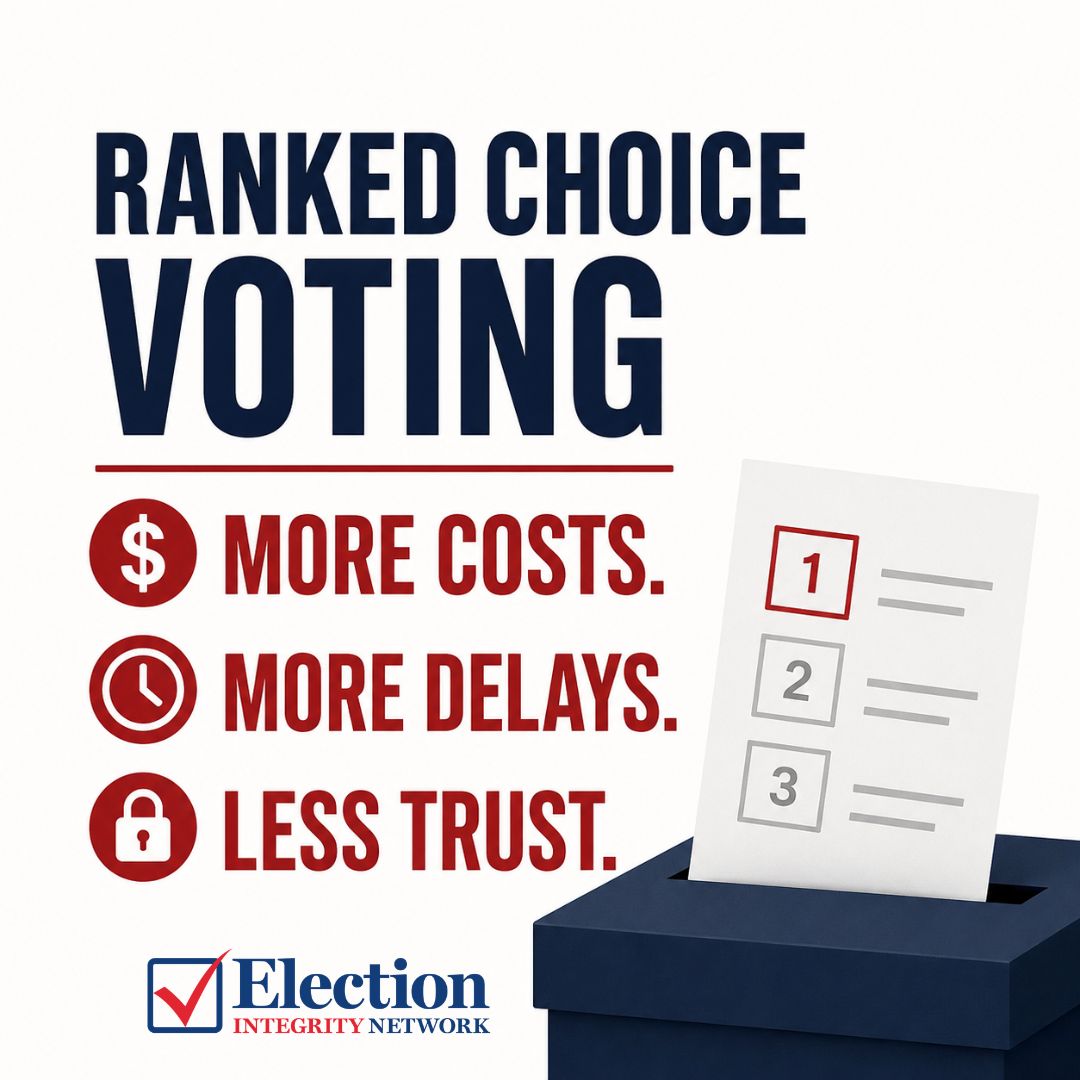

Today marks the final day to vote absentee in person with your town clerk for Maine’s June 9th open primary, which if you are not planning to vote on Election Day, I highly suggest you do before the close of business today. As voters head into crowded gubernatorial and legislative primaries, they face a ranked-choice voting (RCV) system that turns Election Night into a multi-week process of centralized tabulation, added technical risks, taxpayer costs, and voter confusion.
I served as a Maine town clerk during the 2018 elections—the first year RCV was implemented for federal general elections and state primaries—and later observed the tallying process as an election integrity advocate. From the clerk’s desk and the counting tables, the practical burdens are clear: RCV complicates administration, delays results, increases costs, and reduces transparency compared to traditional plurality voting.
How RCV Disrupts Election Night and Local Operations
Under Maine’s system, local election officials led by town and city clerks count only first-choice votes on Election Night and report those results to the Secretary of State. If no candidate reaches a majority (over 50.1% of first choices), paper ballots and memory devices are securely transported to a central counting facility in the state’s capitol of Augusta. There, the Secretary of State’s election team conducts the multi-round RCV tabulation with the assistance of ES&S representatives: eliminating the lowest candidate round by round and redistributing preferences until a majority is reached.³
Clerks must submit unofficial results within two days. When a runoff is triggered, a contracted courier collects sealed memory devices and locked ballot boxes from affected municipalities (for statewide races that means over 500 municipalities). Processing occurs on a closed system during business hours in a public proceeding—loading ballots into high-speed tabulators, uploading memory devices, and hand-entering unreadable ballots. A full statewide tabulation typically takes 1.5 to 2 weeks, with final certification up to 20 days after the election.
This centralized approach eliminates the traditional recovery period for clerks after 30 days of early voting and Election Day. Clerks remain on call for courier coordination and ongoing interaction with the Secretary of State’s office, while state staff handle secure transport, chain-of-custody, high-volume tabulation, data entry, and accuracy reviews—all concentrated in one Augusta location.
Technical Risks and Real-World Glitches
The added complexity introduces technical vulnerabilities. In November 2022, during the 2nd Congressional District runoff, a memory-stick glitch prevented the system from reading ballot images from Bangor and Hampden. Staff had to retrieve and rescan more than 16,000 paper ballots.¹˒² This caused a one-day delay, extra courier trips, law enforcement assistance, additional labor, and extended equipment use—all at taxpayer expense while voters waited longer for results.
Multi-column ballots also increase the risk of voter marking errors (such as over-voting the same ranking or skipping rankings improperly), which can void choices or exhaust ballots entirely when voters don’t rank enough candidates or when preferences cannot transfer.
Significant Added Costs to Taxpayers
RCV is not free. In 2018, Maine spent an additional $441,804 beyond regular election expenses on startup hardware, software, tabulator rentals, couriers, and extra printing. With roughly 965,000 registered voters, this equated to about 46–48 cents per registered voter (or roughly 68 cents per ballot cast in the 2018 general election with 646,013 ballots). Even in higher-turnout years like 2024 (842,447 ballots), recurring costs for couriers, central processing, and potential glitches continue to burden taxpayers.
The system’s rigidity compounds the expense: Maine law requires full RCV tabulation whenever no candidate reaches a majority in round one—even if the outcome is obvious and a candidate concedes—incurring unnecessary costs for the central facility, software, staff time, and transport.
Voter and Clerk Confusion, and a History of Legal Battles
Voters, candidates, and even some clerks remain confused by the ranking process. Official instructions warn against common mistakes, yet multi-column ballots still create widespread issues. Skipping a first choice is allowed (treating it as blank on Election Night but advancing later preferences centrally), but the format invites errors.³
The path to RCV in Maine was itself contentious. Proposals began in 2001, a 2016 citizens’ initiative narrowly passed, but the Maine Supreme Judicial Court struck down key parts for state offices as unconstitutional. Lawmakers passed delay and repeal efforts, and voters weighed in via People’s Veto. Most recently, on April 8, 2026, the Maine Supreme Judicial Court struck down Democratic legislation to expand RCV to governor and state legislature races, reaffirming that the state constitution requires plurality voting—the candidate with the most votes wins—and that RCV’s redistribution process is incompatible without a constitutional amendment.⁴
High-profile examples illustrate the disconnect: In 2018’s 2nd Congressional District, incumbent Bruce Poliquin led after the first round but lost to Jared Golden after second choices from eliminated independents were redistributed. Similar full tabulations occurred in 2022 despite clear trajectories.
The Bottom Line
Ranked Choice Voting was sold as a way to make every vote count and produce majority winners. In practice, Maine’s experiment has delivered added complexity, higher taxpayer costs, less transparent centralized counting, persistent voter confusion, extended delays, and a long trail of legal and legislative battles. With multiple candidates in the June 9th primaries, more rounds of tabulation—and more cost and delay—are likely.
Maine voters deserve timely, transparent, and efficient elections. Other states should closely examine these real-world burdens on local clerks, election staff, taxpayers, and voters before adopting similar systems. Traditional plurality voting remains simpler, faster, cheaper, and more aligned with Maine’s constitutional framework.
Footnotes
¹ Maine Public, “Ranked-choice runoff in Maine’s 2nd District delayed after memory stick glitch,” November 15, 2022. https://www.mainepublic.org/politics/2022-11-15/ranked-choice-runoff-in-maines-2nd-district-delayed-after-memory-stick-glitch
² Spectrum News, “Ranked-choice count for 2nd CD race delayed until Wednesday,” November 15, 2022. https://spectrumlocalnews.com/me/maine/news/2022/11/15/ranked-choice-count-for-2nd-cd-race-is-underway
³ Maine Secretary of State, Ranked-Choice Voting FAQ. https://www.maine.gov/sos/sites/maine.gov.sos/files/content/assets/rcv-faq.pdf
⁴ Ballotpedia News, “Maine Supreme Court says bill expanding ranked-choice voting is unconstitutional,” April 8, 2026. https://news.ballotpedia.org/2026/04/08/maine-supreme-court-says-bill-expanding-ranked-choice-voting-is-unconstitutional/
Additional Reference Sources (for background and verification):