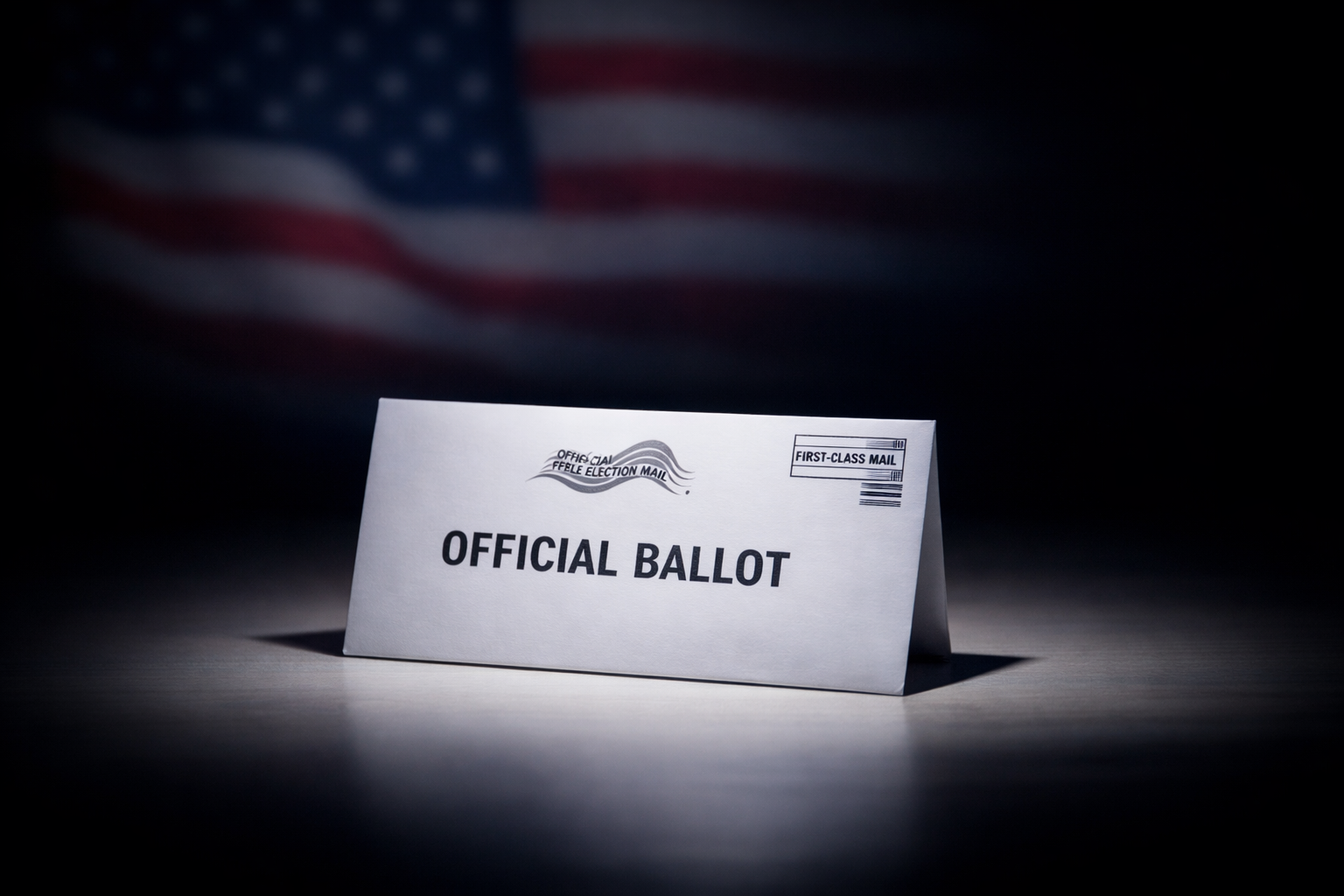

Most people are told that putting a ballot in the mail is “just as good” as walking into a neighborhood polling place. For many voters, it does not work out that way.
Imagine a voter who does everything right. She registers on time, requests a ballot early, and uses the same address she always has. She waits. Campaign flyers arrive, bills arrive, packages arrive. Her ballot does not.
After the election, she contacts the local election office. On their screen, it looks simple: a ballot was mailed to her weeks ago and was never returned. As far as the records are concerned, she chose not to vote.
“In a recent national election, states rejected roughly half a million mail ballots — about 1.5% of all those cast by mail — and many of those were thrown out simply because they arrived too late to count.”¹ ² ³ In person, by contrast, only a tiny fraction of ballots are ever rejected at all.⁴
From the outside, those are just “undeliverable” or “missing” ballots in a large system. For each voter, it is the loss of the one voice they have in their own government.
Most mail ballots are not sent to election offices. They go to ordinary homes, apartments, dorms, and commercial mailboxes. That is where many of the quiet problems start.
In a busy household, one person brings in the mail and sorts it on a counter. Roommates or family members sometimes open each other’s mail “by mistake.” In some homes, one person controls the mailbox key and decides what gets handed over and what gets “lost.” In others, an abusive partner or domineering relative sees every envelope before anyone else does.
Now put ballots into that picture. A mail ballot is just one more envelope in a stack. It can be:
In student housing, the risks multiply. Mailrooms are often run by overworked staff or students juggling thousands of pieces of mail. Roommates move in and out, share space, and sometimes share mail. A ballot can sit in a campus box no one checks for weeks, or be picked up by someone who knows it belongs to a student who rarely complains.
Commercial mailbox stores and virtual office suites are another version of the same problem. A ballot sent to a UPS‑style mailbox may pass through several employees before it reaches the box. Shared business boxes blur who is allowed to open what. A ballot that looks like “just another letter” can be copied or discarded with little chance of anyone noticing.
In all of these settings, the same thing is true: other people have the chance to see, delay, or interfere with a voter’s ballot before the voter does.
Even when a ballot survives the household or mailbox level, it still has to pass through the postal system on the way out and on the way back.
Modern routing changes mean that, in many areas, election mail no longer travels straight across town. Local envelopes are collected, sent to a regional processing center — sometimes in another state — and only then sent back for delivery. Each extra leg adds days, more handling, and more chances for a ballot to be misrouted or stuck in a backlog.
“Postal officials emphasize on‑time percentages above 99.9%, but when tens of millions of ballots move through the mail, even that small remaining slice means tens of thousands of envelopes outside the window state laws assume.”⁵ In earlier elections, tens of thousands of voters had their ballots rejected for lateness alone, even though many mailed them by the date they were told was safe.³
On paper, the system counts trays and percentages. In reality, each missing or delayed envelope is one voter whose voice may never be heard — and who may never be told that anything went wrong.
Whether the problem happens at the front door, in a college mailroom, at a mailbox store counter, or inside a distant processing center, the pattern is the same: the further a ballot travels from the voter and the more people and places it passes through, the less control that voter has over what happens next.
Once a ballot leaves the voter’s hands:
“By design, mail ballots are rejected at far higher rates than in‑person votes, with absentee rejection rates around one percent versus a tiny fraction of a percent for polling‑place ballots.”¹ ⁴ In person at a precinct, the voter hands a ballot directly to an election worker and can see it go into a ballot box or scanner. In mail‑heavy systems, that direct line of sight disappears, replaced by layers of private spaces and distant facilities that ordinary citizens never see.
This is not an argument against helping people who truly cannot get to a polling place. It is an argument against pretending that every path is equally safe.
A voter centric system:
Anything less quietly shifts risk away from institutions and onto individuals whose voices can be lost without a trace.
You only get one ballot. The systems around it should be built to protect that fact — not to treat it like ordinary mail.